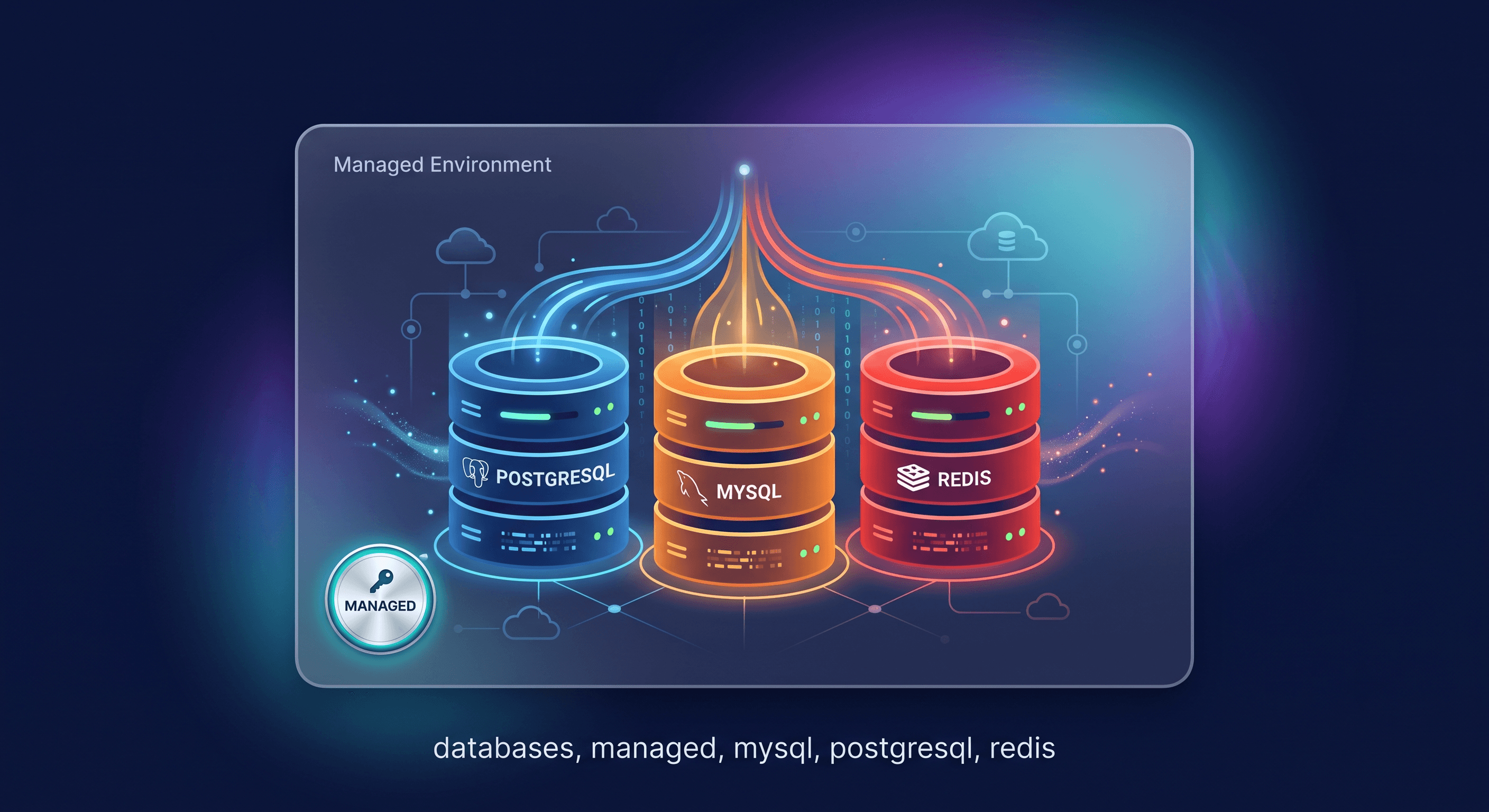
Managed databases used to mean provisioning, patching, and backup chores on top of everything else. Now every MonkeysCloud project gets MySQL, PostgreSQL, and Redis provisioned and managed as part of the environment itself.
The Database Was Always the Part You Dreaded
Code deploys got easy years ago. Push to a branch, watch a pipeline, get a URL. But the database was always the part that refused to fit into the neat flow — because it's stateful, because it needs backups, because it needs patching, because you can't just "redeploy" a database the way you redeploy a container. Every platform that claims deployment is solved quietly assumes you'll figure out the database yourself.
We never liked that assumption, so we removed it.
Every MonkeysCloud project now ships with managed MySQL, PostgreSQL, and Redis, provisioned as part of the environment itself — created with the project, scoped to the environment, connected by environment variables, and managed by us.
This post is about what that actually changes, and what "managed" means at the level where it matters: not in the marketing copy, but in the day-to-day.
What You Get, Concretely
When you create an environment, three data services come with it — not as add-ons, but as part of the environment's lifecycle:
PostgreSQL — for the stacks that want it: Django, Rails, Go apps with a relational core, anything where JSONB or strict transactions matter.
MySQL — for the stacks that grew up on it: WordPress, classic PHP, and the large ecosystem of tooling that assumes MySQL's behavior.
Redis — for caching, sessions, and queues. The thing that every tutorial tells you to "add later" now exists from the start, so later never becomes a migration.
All three are provisioned per environment. Your production environment gets its own database instance; your staging environment gets its own. The isolation rules hold by construction, because isolation isn't a setting — it's how the environment is built.
What "Managed" Removes From Your Plate
"Managed" can be a lazy word, so let's be specific about the jobs we're taking over:
Provisioning. No "create instance → wait 10 minutes → configure network access → grab the endpoint." The database is there when the environment is there.
Credentials. No
DATABASE_URLhunt through a cloud console. Your app gets connection details injected into its environment automatically, and secrets stay out of your repo.Backups. Automated snapshots on a schedule, with restore tooling in the dashboard. You don't write the backup cron job; you don't pray it works.
Patching. When a critical engine update ships, we apply it — not you, at 2 a.m., mid-incident.
Monitoring. Databases surface in the same health dashboard as your servers. A slow query trend or a failing replica shows up where you already look.
Scaling. Outgrow the baseline? Upgrade storage or connections from the environment settings instead of rebuilding infrastructure.
The test of good managed infrastructure: You should stop thinking about the database as infrastructure and start thinking about it as data. The schema, the queries, the indexes — that's your work. Everything around it is ours.
Redis as a First-Class Citizen
We specifically want to call out Redis, because it's the most under-provisioned piece of modern infrastructure. Almost every app eventually needs it — for sessions, for caching hot queries, for a queue — and almost every team adds it as a side quest: spin up a second instance on the side, wire up a client, keep the two in sync with the rest of the stack. On MonkeysCloud it's just there, next to your SQL database, with a connection string already in your environment.
That one change has a bigger effect on performance than most optimizations teams will ever write: a Redis-backed cache turns repeated queries into memory hits, and a Redis-backed session store survives deploys instead of logging everyone out.
Why Per-Project Instead of One Big Shared Instance
Some platforms run one giant database and hand out "databases" as logical tenants on it. That's cheaper for them, but it's worse for you: noisy neighbors, no per-tenant backup isolation, and a ceiling you can't see until you hit it.
We provision real, per-project instances instead. The cost difference is ours to absorb — the isolation is yours to keep. Your backups are your backups. Your connections are your connections. When you restore from a snapshot, you're not crossing a boundary that another tenant shares.
The Workflow It Unlocks
With managed data services in the environment, deployment gets the property it always lacked for stateful workloads: repeatability. The same push that deploys your code can now migrate your schema, warm your cache, and verify your data layer — because the environment owns its database and knows how to talk to it.
Push to staging → schema sync runs against staging's database → migrations prove themselves → promote to production.
A deploy rolls out → Redis cache warms → sessions survive → no logout storm.
Something breaks → restore the snapshot → investigate against real data shape, not a mock.
That's the loop. Stateful deployments stop being scary the moment the state is managed by the same system that manages the code.
Closing Thought
We built MonkeysCloud because deployment should be a solved problem — and a solved problem can't have "oh, and set up your own database" as a footnote. Managed MySQL, PostgreSQL, and Redis per project close that gap. The database is now part of the environment: provisioned with it, scoped to it, backed up, patched, and monitored — and connected to your app before your first deploy finishes.
Every MonkeysCloud project ships with 2 free servers and 2 free databases — git hosting, environments, CI/CD, and MonkeysAI included. Try it free