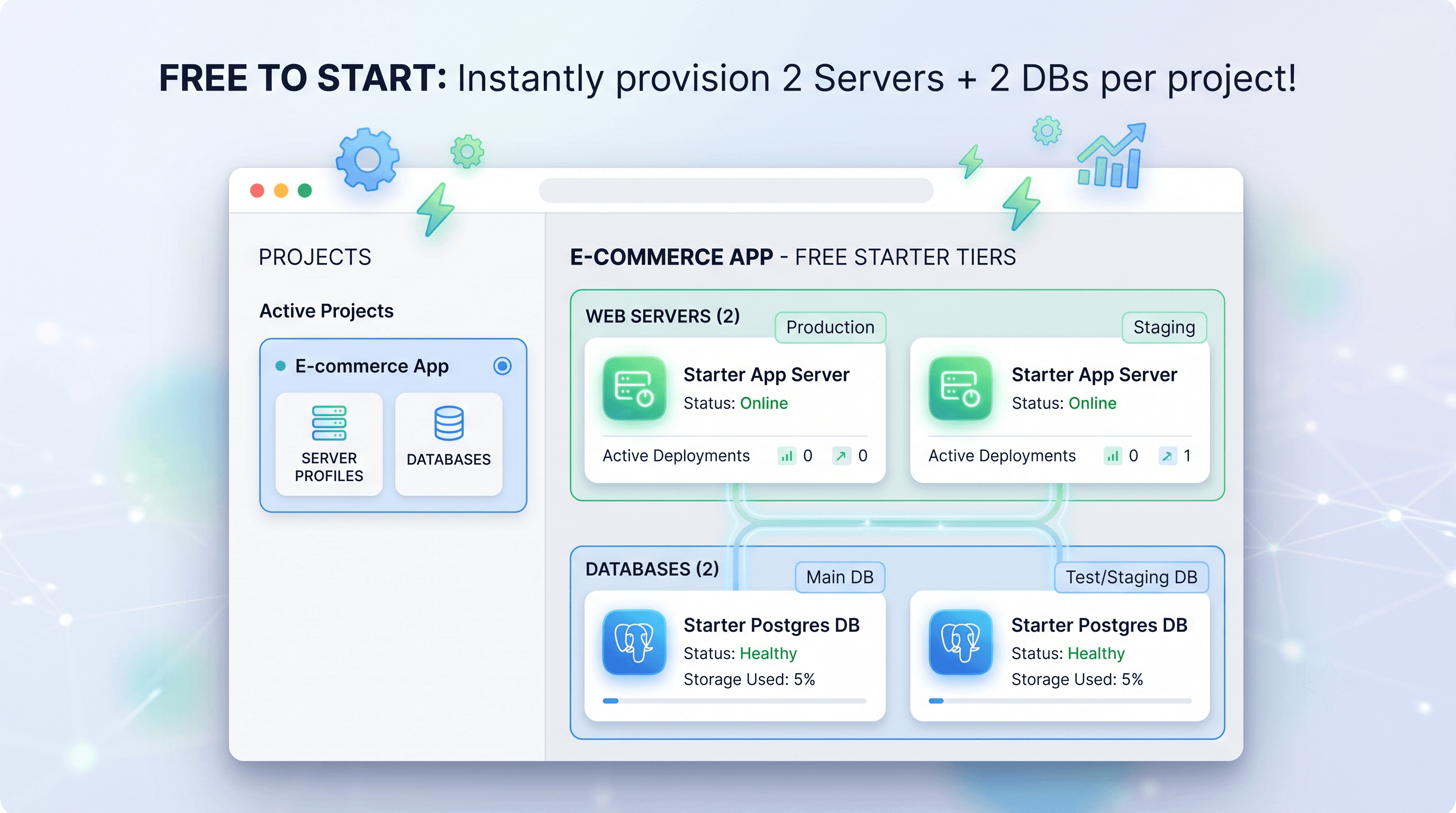
Every project on MonkeysCloud ships with 2 managed servers, 2 databases, git hosting, CI/CD, and an AI assistant — free, no credit card. Here is the thinking behind that decision.
The Moment Most Products Die
Most software products don't die because the code is bad. They die because the team can't find out whether anyone wants the thing before the infrastructure bill arrives. You have an idea on a Friday night, and by Monday you're comparing VM pricing tiers, choosing between managed Postgres plans, and wondering whether a "free tier" that expires in 90 days counts as free at all.
We watched this happen to founders we know. A friend's side project — a genuinely useful internal tool — sat in a private repo for six months because "I'll deploy it once it's ready." Ready never arrived. The friction wasn't in the code. It was in the dozen decisions between "I have code" and "it's live": pick a cloud, pick a database, configure DNS, set up CI, manage SSH keys, remember to pay the bill.
The free-to-start philosophy is our answer: remove every decision and every cost between having code and having it live.
What "Free to Start" Actually Includes
When you create a project on MonkeysCloud, you get baseline infrastructure that never expires and never asks for a credit card:
2 managed servers — one for production, one for staging, both real virtual machines on Google Cloud, both behind load balancers with automatic SSL.
2 managed databases — typically one MySQL and one PostgreSQL, isolated per environment so production data can never be touched by a staging deploy.
Git hosting on our own Go server, with SSH key isolation per organization.
CI/CD — a full pipeline that builds on push, runs your
monkeyscloud.ymlrules, and deploys to a live URL.MonkeysAI — the assistant that diagnoses builds, reviews pull requests, and triages your backlog.
That's not a trial. That's not a "starter plan" that silently becomes a bill. It's the same infrastructure a paying project gets, just provisioned free so the decision to commit happens after you've seen the product work — not before.
Why "Free Tier with a Clock" is a Trap
Most platforms give you a 14-day trial or a limited free tier with an expiring credit. The message it sends is: the clock is running, and you should already be generating revenue. For a team validating an idea, that's exactly backwards. Validation takes as long as it takes. Some ideas prove themselves in a weekend; others take six weeks of real usage from real users.
A clock changes your behavior:
You rush features instead of listening to users.
You spend the trial worrying about the bill instead of the product.
When the trial ends, the migration off the platform is a tax on everything you learned.
We'd rather have a project that runs free for two months, finds product-market fit, and then upgrades because it genuinely outgrew the baseline — than a project that churns after 14 days because the trial expired.
The Honest Economics
Is giving away two servers and two databases sustainable? For us, yes — and the math is worth spelling out, because we think most teams would rather have a vendor that's honest about the economics than one that hides them.
The baseline infrastructure for a small project costs us a modest amount per month. Most projects never use their baseline fully. And the projects that do outgrow it upgrade to paid environments — which is exactly when they have revenue and the cost is trivial relative to what they're shipping. We're not subsidizing free users with hidden fees; we're treating baseline infrastructure as a marketing expense with the best possible conversion funnel: a product that already works.
Compare that to the traditional path: a team pays a cloud provider directly, and the cloud provider makes money whether or not the product works. We only make money when the product works — which aligns our incentives with yours.
What Changes When Starting is Free
Removing the cost barrier changes team behavior in measurable ways:
Ideas get deployed, not shelved. The six-month gap between "I have code" and "it's live" collapses to an afternoon.
Staging stops being optional. When a second environment is free, teams actually use it — and the "works on my machine" class of bugs mostly disappears.
Experiments become cheap. Spin up a branch environment for a spike, show it to a customer, tear it down. The cost of learning is now your time, not your wallet.
The AI assistant starts helping from day one. MonkeysAI reviews your first pull request, not your tenth. Teams that start with an assistant in the loop keep it in the loop.
What "Free" is Not
Let's be clear about what free doesn't include. We're not offering unlimited everything. Production environments that need more CPU, memory, or replicas cost money. Additional databases, larger instances, and longer backup retention are paid. That's fair — and it's also the point: you pay when you're shipping something real, not when you're checking whether the idea works.
Closing Thought
The best product decisions remove friction between intention and outcome. The free-to-start philosophy is that idea applied to infrastructure: no credit card, no clock, no spreadsheet of instance types — just code, a push, and a URL.
Start free on your next project. If it works, we'll grow with you. If it doesn't, you spent nothing but your time — which is exactly how validation should feel.
Every MonkeysCloud project ships with 2 free servers and 2 free databases — git hosting, environments, CI/CD, and MonkeysAI included. Try it free