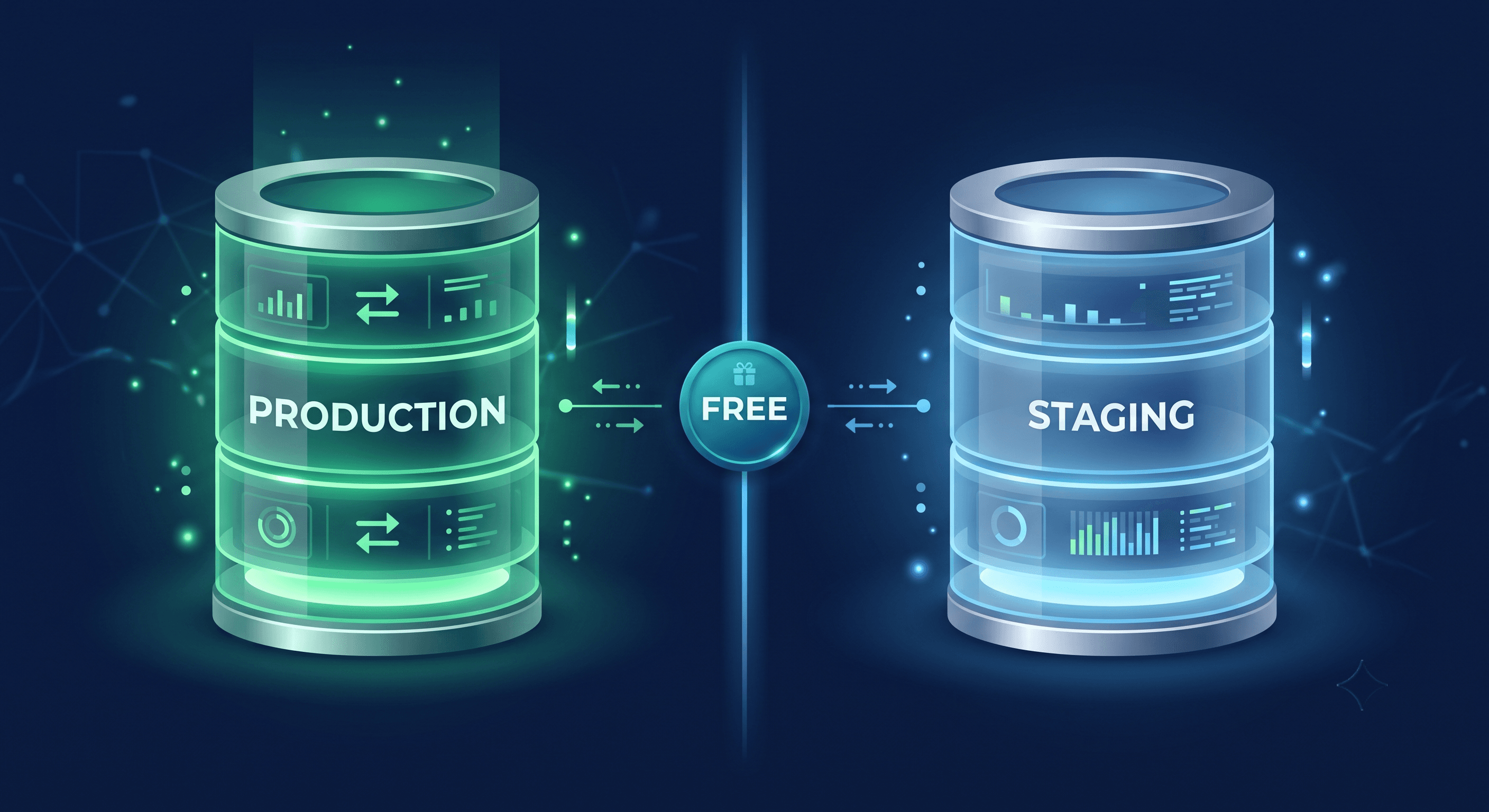
One database for a project is how "works on my machine" becomes "it worked in staging." Here is why every MonkeysCloud project provisions two isolated, managed databases from day one — and the cost math that makes it free.
The Shared-Database Trap
There is a moment in almost every young project where someone connects the staging environment to the production database. It rarely looks like a mistake at the time. The schema is the same, so the code works, and the team saves the $15/month it would cost to run a second instance. Then, one Thursday afternoon, a staging seed script truncates a table that production actually needs, and the team learns the difference between "the same database" and "the same kind of database."
The shared-database trap isn't about being careless. It's about the fact that for most of a project's early life, a second database feels like an expense with no visible return. So teams share one — and the bill arrives later, in the form of corrupted data, weird test state leaking into user-visible behavior, and "it worked in staging" becoming a punchline.
Every MonkeysCloud project ships with two databases from day one. Not a second database you can pay for later — two, provisioned at project creation, isolated between production and staging, both managed, both free.
This post is about why that's not generosity so much as it is good engineering that happens to be free.
Why Two, and Why Isolated
The rule is simple: production data and test data must never share a process. Here's what sharing actually costs:
Destructive operations get scoped wrong. A migration that truncates a staging table shouldn't be able to reach production rows. With one database, there is no boundary — just hope and a review process.
Seed data becomes invisible. When a developer resets "the database" to get clean test data, they may be resetting data other developers (or worse, users) are reading. Two databases make the reset boundary explicit.
Bugs become untestable. The class of bug that only appears with real data volumes, real row counts, or real index pressure can't be reproduced in staging if staging and production are the same table. Two databases let staging approximate production instead of pretending to be it.
Backups get muddled. You want production backups to be sacred and staging restores to be disposable. One database forces you to make that distinction with tooling and discipline; two databases make it structural.
Two isolated databases don't just prevent the catastrophic version of this — they prevent the daily friction version. A developer can wipe staging freely, seed it with fixtures, run destructive migrations, and never once think "I hope that was the right environment."
Why MySQL and PostgreSQL
Most platforms make you pick a database and live with it. We provision one MySQL and one PostgreSQL per project, and the choice is deliberate. We built the platform to be multi-stack — 32+ frameworks auto-detected — and the database should match the stack, not the platform's convenience.
A Django or Rails app feels at home on PostgreSQL; a WordPress or legacy PHP app has MySQL in its bloodstream. By giving you both from the start, the platform removes the "should we migrate databases later" conversation entirely. You connect to the one your stack fits, and the other sits there as a free option — Redis for caching and queues is on the roadmap the same way.
What "Managed" Means in Practice
"Managed" is one of those words that can mean anything, so here's what it means on MonkeysCloud specifically:
Backups on a schedule — automated snapshots you can restore from, with retention you control.
Patching and updates — the platform upgrades the engine, not you. No 2 a.m. "PostgreSQL released a security patch" surprise.
Health monitoring — the same uptime checks and alerting that watch your servers also watch your databases, and a failure surfaces in the same dashboard.
Connection details in your environment — your app gets a connection string via environment variables, injected at deploy time. No hunting through cloud consoles for credentials.
Schema changes you can actually run — our schema-sync flow diffs your entity layer against the live database and applies only what changed, so the "migrations vs. schema drift" debate mostly disappears.
The Cost Math (and Why It's Free)
Here's the honest version: a single small managed database on a public cloud runs roughly $10–20/month, and a second one for staging means doubling that. For a project without revenue, that's a real tax — the exact tax that pushes teams into the shared-database trap in the first place.
On our side, the marginal cost of provisioning a second, small, managed database is a fraction of that retail price, and the engineering benefit — fewer data-related incidents, higher-confidence deploys — is worth far more than the cost.
The free-to-start philosophy applies here precisely: the second database prevents the most expensive class of mistakes a young team can make, so we make it free and structural rather than paid and optional.
When you outgrow the baseline — more storage, more connections, a dedicated replica, longer retention — you upgrade a database the same way you upgrade an environment. The free tier isn't a demo; it's the foundation.
What Teams Actually Do With It
Once both databases exist, the good habits follow naturally:
Staging gets its own seed strategy — fixtures, not production copies, so tests are deterministic.
Production restores stay sacred — you can restore a backup into staging to investigate, but staging can never write back up.
Destructive migrations run in staging first — every migration proves itself against staging's schema and data shape before touching production.
The AI assistant checks both — MonkeysAI can diff environment configs and flag when a setting exists in production but not staging, and vice versa.
Closing Thought
A second database isn't a luxury once you've shipped — it's the difference between data you trust and data you're quietly nervous about. By shipping two isolated, managed databases with every project, free, we made the safe choice the default choice.
That's the whole philosophy in miniature: remove the decision, remove the cost, and teams will do the right thing without thinking about it.
Every MonkeysCloud project ships with 2 free servers and 2 free databases — git hosting, environments, CI/CD, and MonkeysAI included. Try it free